
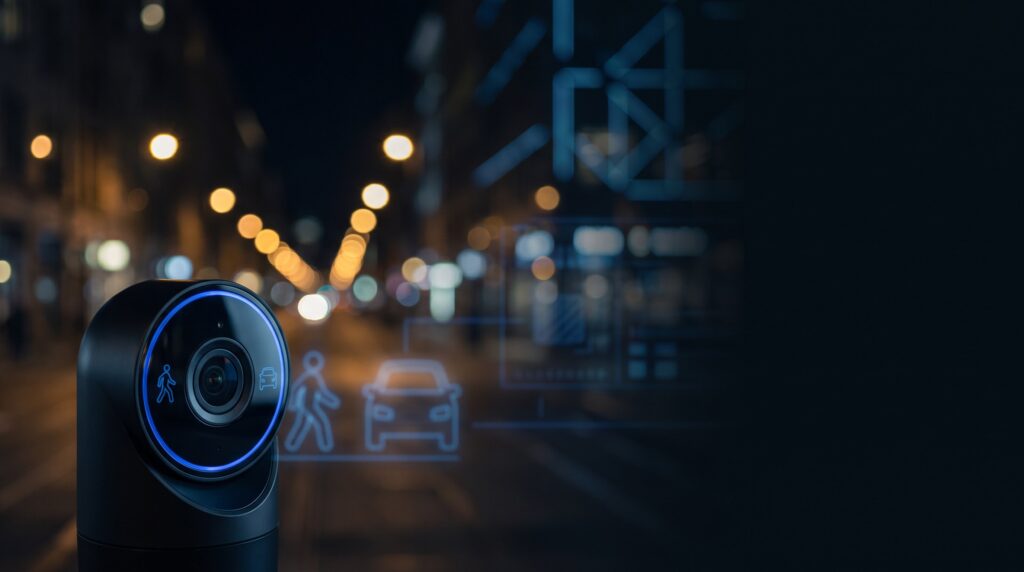
Most secured sites already have far more cameras and sensors than any team can watch. Detection capability is rarely the gap. Human attention is. Footage gets reviewed after an incident rather than during one, and the interval between something becoming visible and somebody acting on it is where the damage happens.
Nexus is a software layer that makes the equipment already in place work harder. It is not hardware, and it does not replace anything. It connects to the cameras, access control, perimeter sensors and communications systems an organisation already runs, watches all of them continuously, and notifies the responsible people the moment something needs a decision. It reads standard video, and it also reads thermal and LiDAR feeds where those exist. The detection models and the reasoning that links events across separate systems are built in-house and owned outright. The platform has been in development since 2015.
Defense and force protection
For installations, depots, forward sites and diplomatic facilities, Nexus keeps an automated watch over perimeters and access points. It recognises a firearm, a person on the ground, an unattended vehicle, a breach at a gate or fence line, and approach behaviour that does not fit the site’s normal pattern. Alerts route by role and by rank, and acknowledgement is tracked, so a warning cannot die simply because nobody happened to be looking at the right screen. Notifications go out by SMS, email, Microsoft Teams, or straight to a response monitoring centre.
One point deserves emphasis. Nexus identifies and it notifies. It does not act on its own authority. What follows an alert is defined entirely by the command structure of the organisation deploying it, and every event, notification and action is logged for accountability and after-action review. The effect is to give commanders more time and better information, not to remove them from the decision.
The practical result is force multiplication. A small watch team can supervise coverage that would otherwise take many times the manpower, and personnel spend less time on routine monitoring in exposed positions.
Existing police and municipal networks
The same layer applies to public safety. Cities across the region and beyond have already spent heavily on camera networks, and most of that footage is reviewed only after the fact. Nexus turns those networks into an active capability. It watches every feed in real time rather than sampling a few, follows a vehicle or a person of interest from camera to camera, reads plates at defined points, and turns what would be days of manual review into a search that takes minutes.
No new cameras are required, and nothing already installed has to come out. That matters where budgets are committed and the infrastructure is already in the ground.
Sovereignty, control and ownership
Nexus can run entirely on premises, including in fully isolated environments. Video and data stay where the client puts them, encryption keys stay in the client’s hands, access is controlled by role, and the audit trail is complete. This is the deciding factor wherever information cannot be allowed to leave a facility or a jurisdiction.
Because the technology is owned rather than licensed from a third party, it can be transferred, licensed onward or handed over in full. The detection set is not fixed either. Beyond weapons and intrusion, it covers falls, unattended doors, loitering, crowd formation, plate reads and person counting, and it keeps learning with every model release. On construction sites the same platform runs on solar-powered mobile towers that lock down a site or trigger notifications on their own. In a plant it reads equipment status and process data against a live facility twin. It is the same engine each time, pointed at a different problem.
Nexus Technologies is a portfolio platform of Infinity Technologies Fund. Platform diligence materials are available to qualified investors.