
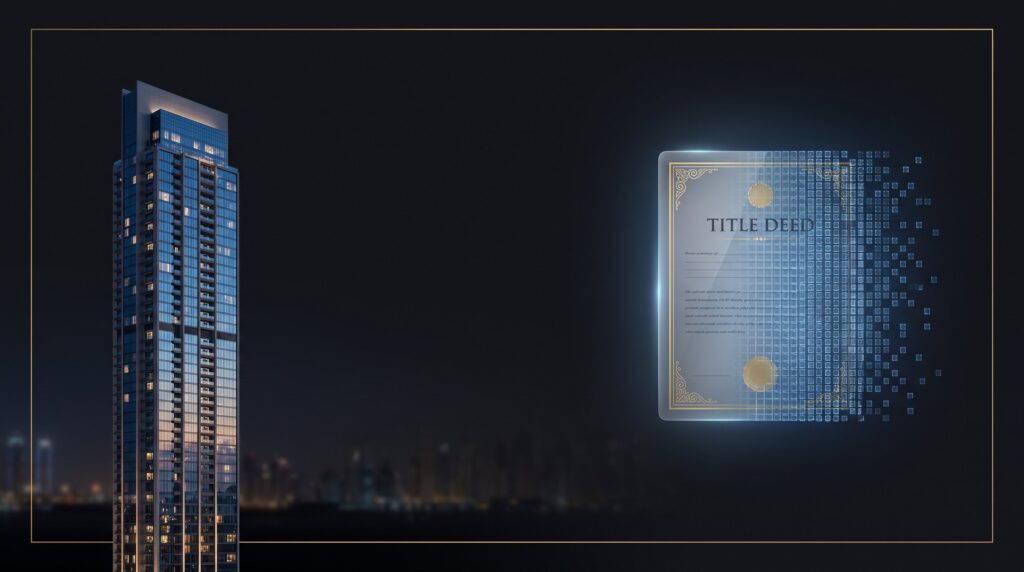
In May 2025 a two-bedroom apartment in Business Bay’s Damac Prive Tower, listed at AED 2.4 million, found 224 buyers from 44 countries. It sold out in under a day. Not one of them bought the flat. They bought tokens tied to its title deed, issued under a pilot the Dubai Land Department ran with VARA and the Central Bank of the UAE.
That sentence contains the whole thing, and the part most tokenisation pitches skip. The token is not the asset. It is a claim on a legally registered right, and in Dubai that right now sits on a DLD title deed, denominated in dirhams, not in crypto. Get that backwards and you have built a certificate nobody is obliged to honour.
Where the UAE actually is
The DLD pilot ran from May 2025 to February 2026 and moved more than AED 18.5 million from investors across 50-plus nationalities. The department expects tokenised property to reach AED 60 billion by 2033, roughly 7 percent of all Dubai real estate transactions. Phase two added a regulated secondary market, built with VARA, the Dubai Future Foundation and the Central Bank, so a holder can sell without waiting for a buyer for the entire asset.
Step back and the direction is the same everywhere. Tokenised real-world assets on public chains, setting stablecoins aside, grew from around $5 billion at the start of 2025 to more than $24 billion within three years. Property is a small slice of that today. It is also the slice with the most obvious problem to solve: entry sizes in the millions, exits measured in months, and cross-border paperwork that has nothing to do with whether the building is any good.
If you own the asset
Three questions decide whether a tokenisation offer is real.
Whose name is the asset in. The credible structures put each property in its own vehicle, usually a DIFC holding company with one special purpose vehicle per asset. One asset, one vehicle. If a single unit underperforms, it should not be able to reach into the others.
What the token actually entitles you to. A share of rent, a share of sale proceeds, a vote, or some combination, and whether those rights are fixed at issuance. Vague answers here are the tell.
Whether you can get out. A token you cannot sell is worse than the illiquid asset behind it, because now you also carry platform risk on top. A regulated secondary venue is the difference between an investment and a trap.
If you issue
The licence comes before the launch, not alongside it. VARA is the reference point in Dubai, with ADGM and the DFSA operating their own regimes in the wider UAE. Raising money first and pursuing the licence afterwards is how a project becomes an enforcement file.
The other thing worth saying plainly: Dubai’s real advantage is the land registry. The DLD will record the arrangement against the deed itself. Most markets talking about tokenised property cannot do that, which is exactly why the pilot happened here and not in a jurisdiction with a friendlier tax rate.
The honest read
Tokenisation fixes the plumbing. It does not turn a tired building into a good one, and it does not repeal the property cycle. What it changes is who can participate and how quickly they can leave. For an owner sitting on an underperforming unit in a strong building, that is a genuine new option. For an issuer, the regulatory pathway is now clear enough that “built to a VARA licence” is a checkable claim rather than a slogan. Anyone who cannot tell you where the title deed sits is selling you the token without the thing underneath it.
Sources: Dubai Land Department; Dubai Media Office; DLD Phase 2 secondary market; CoinDesk, RWA market growth.